Free 13-Week Cash Flow Forecast Template
A weekly cash flow template covering one quarter, the format lenders and turnaround advisers use to manage tight cash.
- Forecast views
- 13-week (weekly)
- Works in
- Excel, Google Sheets
Free
Download freeInside the template
What’s inside
- 13 weekly columns with automatic week dates
- Receipts and disbursements sections
- Minimum cash buffer line with warnings
- Week-by-week closing balance chart
- Works in Excel and Google Sheets
Who this template is for
Businesses that need to manage cash week by week: when payroll runs weekly or fortnightly, when a big customer pays late, when a lender or adviser has asked for a 13-week forecast, or simply when the bank balance is tight and monthly totals hide the problem. It suits service businesses, trades, hospitality, agencies and most small companies.
Why 13 weeks?
Thirteen weeks is one quarter. It is long enough to see a full payroll cycle, a quarterly tax payment and a slow-paying customer at the same time, and short enough that most of the numbers are already known: invoices are out, bills are scheduled and staff costs are fixed. That makes it the most accurate forecast a small business can build, and the one lenders and turnaround advisers rely on. Our 13-week cash flow forecast guide explains the method in detail.
What’s inside
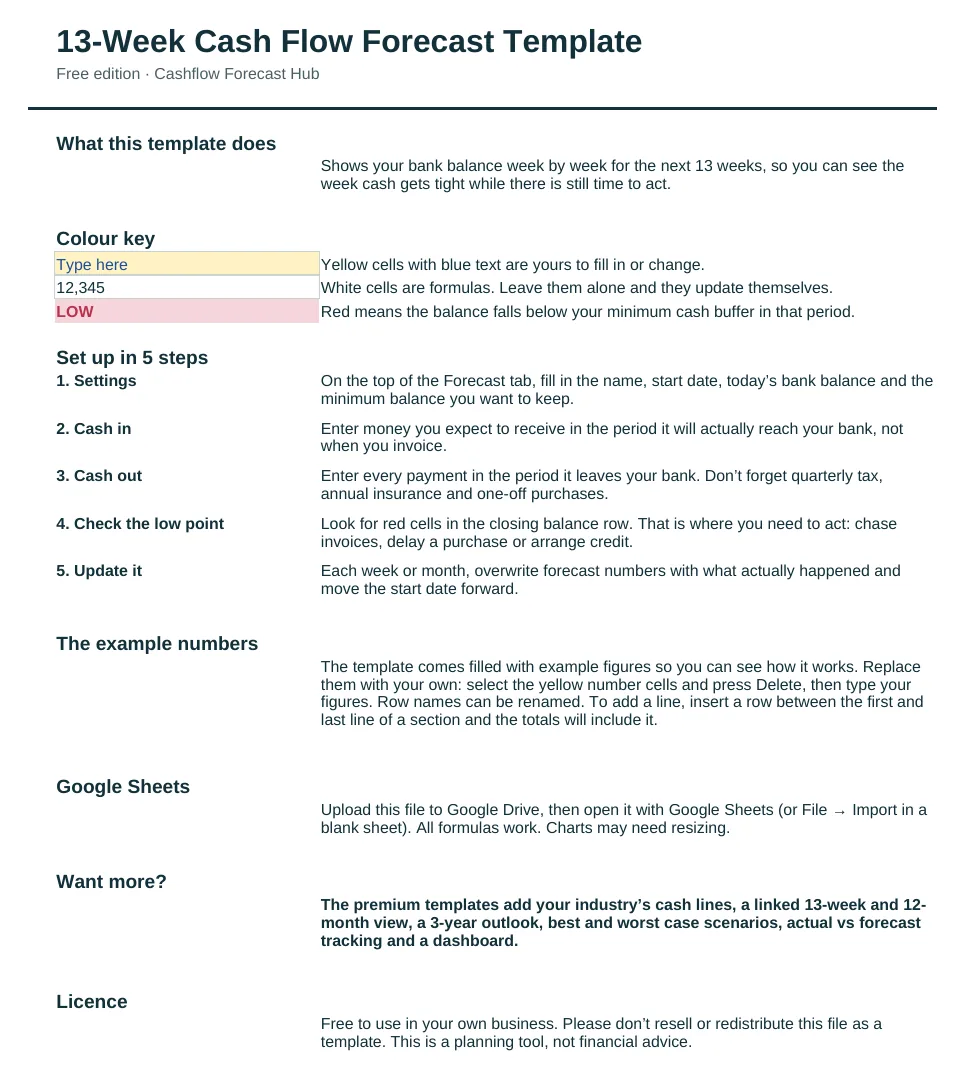
- A Start Here tab with the colour key and setup steps.
- Settings for business name, the Monday your first week starts, bank balance, minimum cash buffer and currency. Week dates fill in automatically.
- Five cash in lines, including collections from existing invoices and new sales, and nine cash out lines, including fortnightly payroll, rent, suppliers, utilities, software, loan repayments and tax.
- Weekly totals, net cash flow and a closing balance that rolls forward, with red warnings for any week below your buffer.
- A summary box with the lowest balance, the week it happens and how many weeks are below your buffer.
- A chart of weekly cash in, cash out and closing balance.
How to use it
- Set week 1 to the coming Monday and enter your bank balance.
- List collections from invoices you’ve already sent, in the week each customer usually pays.
- Add expected new sales and any other income.
- Add payroll on its actual pay dates, then rent, suppliers and every other payment.
- Find the lowest week. If it’s below your buffer, act now: chase receivables, move a payment or talk to your bank.
- Every week, replace week 1 with actual figures, delete it and add a new week 13.
What people use it for
Owners use it to get through a tight quarter, to decide which invoices to chase first, to time a large supplier payment, or to show a bank that they understand their short-term cash. Advisers use it in turnaround and refinancing work, where a weekly forecast updated with actual figures is often a condition of support. It also works well as a weekly habit: fifteen minutes every Monday morning.
Excel and Google Sheets
The .xlsx file has no macros and works in Excel on Windows and Mac, Excel online and Google Sheets.
When to upgrade
Premium industry templates link this weekly view to a 12-month monthly view and a 3-year outlook, and add scenarios, actual vs forecast tracking, a dashboard and industry-specific tabs such as progress billing, stock purchases or subscriptions. See all templates by industry.
Questions people ask
Who uses a 13-week cash flow forecast?
Small and mid-size businesses, lenders, turnaround advisers and finance teams. It is the standard short-term cash forecast in restructuring and banking.
How often should I update a 13-week forecast?
Every week. Replace the finished week with actual figures and add a new week at the end, so it always looks 13 weeks ahead.
Is it free?
Yes. It’s free to download and use in your business.
Can I use it in Google Sheets?
Yes. Upload it to Google Drive and open it with Google Sheets.
What should I put in collections from existing invoices?
Go through your unpaid invoices and place each one in the week that customer usually pays, based on their past behaviour rather than your payment terms. Leave out disputed or very old invoices until they are resolved.