Free Personal Cash Flow Forecast Template
See every pay day, bill and savings transfer for the next 12 months, and the month your account gets tight.
- Forecast views
- 12-month (monthly)
- Works in
- Excel, Google Sheets
- Built for
- Personal & Household
Free
Download freeInside the template
What’s inside
- Income and bill categories for households
- Savings goal tracker
- Monthly closing balance with warnings
- Works in Excel and Google Sheets
Who this template is for
Anyone who wants to see their household money a year ahead: people paid monthly who get caught out by annual bills, couples combining finances, freelancers smoothing irregular income, and anyone saving for something specific. It isn’t a budget that tells you what to spend. It shows when money arrives and leaves, so you can see which months will be tight before they arrive.
What’s inside
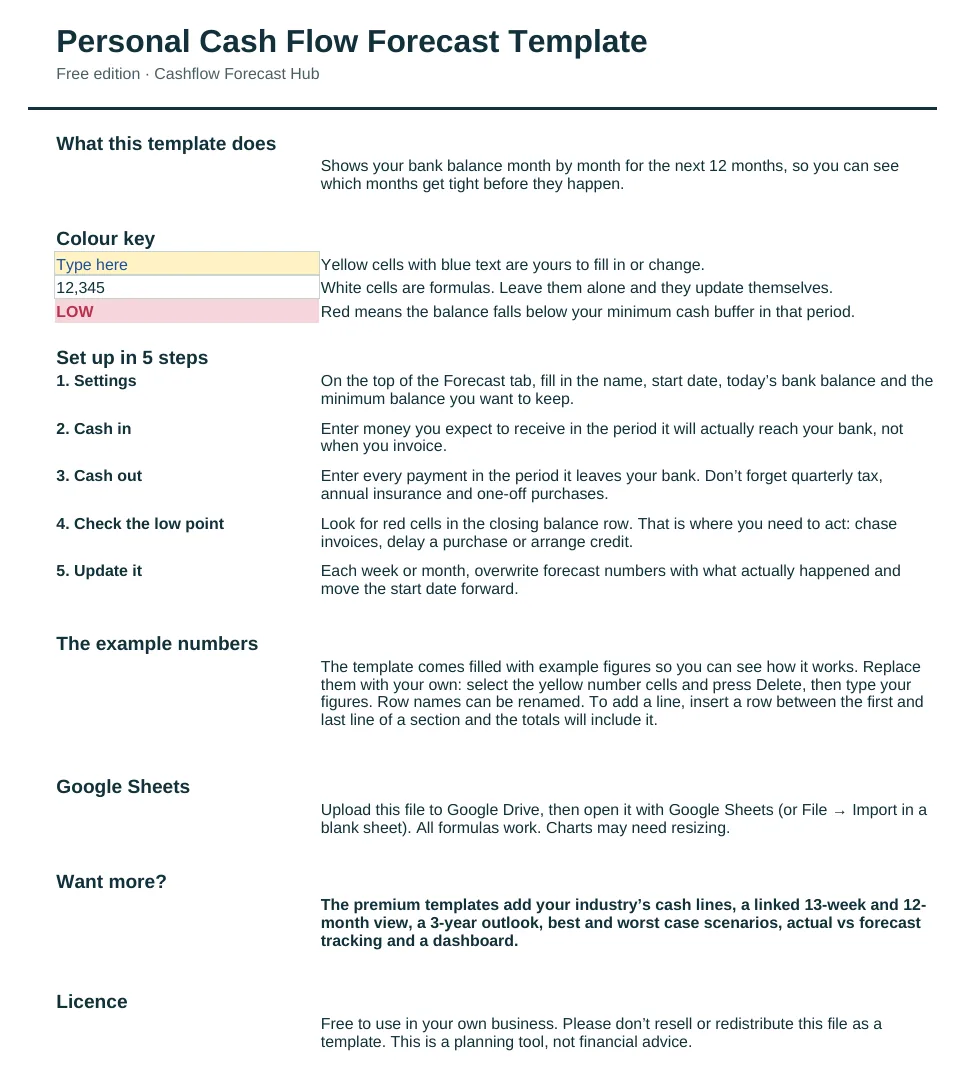
- A Start Here tab with the colour key and setup steps.
- Settings for your name, first month, current account balance, the minimum you want to keep and currency.
- Income lines for salary, a partner’s salary, side income, benefits, tax refunds and other money in.
- Thirteen spending lines, including rent or mortgage, groceries, utilities, transport, insurance, childcare, debt repayments, subscriptions, eating out, gifts and holidays, annual bills and savings transfers.
- Monthly totals and a closing balance that carries forward, with red warnings for any month below your minimum.
- A summary box showing your lowest balance, the month it happens and your balance at the end of the year.
- A chart of money in, money out and balance for the year.
How to use it
- Enter your current account balance and the minimum you want to keep, often one month of essential costs.
- Enter income in the month it arrives. If you’re paid fortnightly, some months have three paydays: put them in.
- Enter regular bills and everyday spending.
- Add irregular costs in the month they fall: holidays, birthdays and festive gifts, car tax, annual insurance and memberships.
- Look at the red months, then spread the cost by saving a little each month beforehand.
The example shows a household that is comfortable most of the year but dips below its minimum around the holidays and when annual bills arrive, a very common pattern.
What people use it for
Households use it to plan for the holidays and annual bills, to see whether a new car payment or a move is affordable, to build an emergency fund month by month, and to agree a shared plan with a partner. It is especially useful if you are paid fortnightly or have irregular income, because it shows exactly which months have more money going out than coming in.
Excel and Google Sheets
The .xlsx file has no macros and works in Excel and Google Sheets. Upload it to Google Drive and open it with Google Sheets to use it on your phone.
Want more?
The premium Personal & Household template adds a 13-week weekly view for payday-to-payday planning, a savings plan tab, a 3-year outlook, best and worst case scenarios and an actual vs forecast tracker.
Questions people ask
Is this personal cash flow template free?
Yes. It’s free to download and use.
What’s the difference between a budget and a cash flow forecast?
A budget sets how much you plan to spend. A cash flow forecast shows when money comes in and goes out, so you can spot tight months in advance.
How much should I keep in my account?
Many people keep about one month of essential costs in their current account, and a separate emergency fund in savings.
Can I use it on my phone?
Yes. Upload it to Google Drive and open it with Google Sheets, which works on phones and tablets.
What if I’m paid fortnightly?
Enter each payday in the month it falls. Two months of the year will have three paydays, and the forecast will show them as stronger months you can use to build savings.